During 2023, an independent agricultural research firm in California tested DZ 9966, a mineral oxychloride disinfectant, on wine grapes and cut sour rot in half while sharply increasing crop yield. Foliar application alone delivered a 50% drop in sour rot compared to the control and a 49% increase in crop yield.
The trial
The study was conducted on 6-year-old French Colombard wine grapes with a history of virus infections that emerged under seasonal stress. Four treatments were applied between April 26 and July 14, 2023.
Application schedule
- Soil irrigation: 78 mg/l concentration
- Foliar spray: 390 mg/l concentration, dosed at 0.05 oz/gal
The trial compared four groups: an untreated control, foliar spray only, soil irrigation only, and a combined foliar-plus-soil application.
Results
A 50% drop in sour rot compared to the control and a 50% increase in crop yield using DZ 9966 through foliar application alone.
Yield improvements
- Foliar treatment produced 73 clusters per 2 vines, a 21.7% increase over the control's 60 clusters.
- Foliar spray produced 76 lbs per 2 vines, a 49.0% increase over the control's 51 lbs.
- The combined treatment achieved the maximum 50% sour rot reduction.
What is DZ 9966?
DZ 9966 is EPA FIFRA registered, USDA NOP certified, and USEPA Water approved.
How does sour rot differ from powdery mildew?
Sour rot is not a single pathogen and that is precisely why it is difficult. It is a complex — yeasts, acetic-acid bacteria, and the fruit flies that move both between berries — that establishes once the skin is compromised by any means: rain-driven splitting, bird or insect damage, or the natural cracking that follows a heat event on a tight cluster. A conventional fungicide programme aimed at a single fungal target does not address a mixed microbial community, and it does nothing about the vector.
The economic damage is disproportionate to the visible infection. Volatile acidity carries into the fermentation, so a modest percentage of affected berries can compromise a whole lot. Growers therefore end up either sorting aggressively at the crush pad or picking early, both of which cost yield or quality. A treatment that reduces incidence in the field is worth considerably more than the acreage number suggests.
Why does an oxidant beat a fungicide?
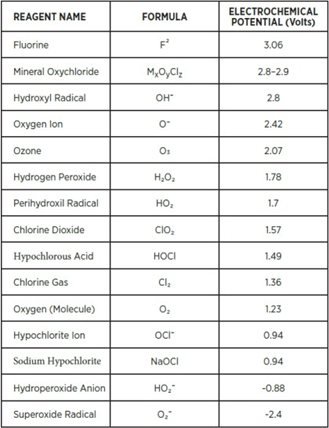
DZ 9966 is a mineral oxychloride that delivers a family of reactive oxygen species — superoxide, hydroxyl radical, singlet oxygen, hydroperoxyl, and peroxide — at an oxidation potential of 2.8–2.9 V. Only fluorine is higher, at 3.06 V.
| Oxidant | Oxidation potential (V) |
|---|---|
| Fluorine | 3.06 |
| DZ 9966 mineral oxychloride | 2.8–2.9 |
| Hydroxyl radical | 2.80 |
| Ozone | 2.07 |
| Chlorine dioxide | 1.57 |
| Chlorine gas | 1.36 |
| Sodium hypochlorite | 0.94 |
An oxidant does not have a single biochemical target, so it is not selective in the way a site-specific fungicide is: yeasts, bacteria, and fungal spores are all susceptible. That non-selectivity is a liability in some settings and an advantage here, because sour rot is a community rather than an organism. It also means there is no single-site resistance mechanism for the population to select for — a real consideration in a vineyard block that has been on the same fungicide chemistry for years.
Reading the trial numbers
| Measure | Control | Foliar treatment | Change |
|---|---|---|---|
| Clusters per 2 vines | 60 | 73 | +21.7% |
| Weight per 2 vines (lbs) | 51 | 76 | +49.0% |
| Sour rot incidence | baseline | — | −50% (combined treatment) |
Two things are worth drawing out. First, weight rose almost 49% while cluster count rose only 21.7%, which means the clusters themselves were heavier — more retained berries per cluster rather than simply more clusters set. That is the signature of reduced in-cluster loss, which is consistent with the sour-rot result rather than independent of it. Second, foliar application alone captured most of the yield benefit; the combined foliar-plus-soil programme was what achieved the maximum 50% sour-rot reduction. For a grower deciding where to spend, that distinction matters.
The vines were 6-year-old French Colombard with a history of virus infection that expressed under seasonal stress — not a clean, easy block. Treatments ran from 26 April to 14 July 2023: soil irrigation at 78 mg/L and foliar spray at 390 mg/L, dosed at 0.05 oz/gal.
How do you run the programme?
Application is dosed to an oxidation-reduction potential setpoint rather than a fixed concentration, so the programme corrects itself for organic load in the irrigation water. The in-field and post-harvest disinfection band is 650–750 mV; the ORP reference chart gives the full set of process targets. The effective pH range is 4–9, which covers most irrigation sources without adjustment, and installation is a metering pump, a storage tank, and an optional ORP controller — typically under 30 minutes.
DZ 9966 is EPA FIFRA registered as a biocide and algaecide and certified under the USDA National Organic Program, which is what allows it in a certified organic block. Related agricultural field work includes powdery mildew control, the Xylella fastidiosa trial, the citrus greening case study, and post-harvest food safety and quality. The full library sits under agricultural research and Food & Agriculture.
Frequently asked questions
What is sour rot and why is it hard to treat?
Sour rot is a complex of yeasts, acetic-acid bacteria, and the fruit flies that spread them, which establishes once berry skin is compromised. Because it is a mixed community rather than a single pathogen, a site-specific fungicide programme does not address it.
How much did yield increase in the vineyard trial?
Foliar treatment produced 76 lbs per 2 vines against 51 lbs for the control, a 49.0% increase, and 73 clusters per 2 vines against 60, a 21.7% increase. The combined foliar and soil treatment achieved the maximum 50% sour rot reduction.
Was foliar or soil application more effective?
Foliar application alone captured most of the yield benefit. Foliar spray produced 76 lbs per 2 vines, a 49.0% increase over the control's 51 lbs, and 73 clusters per 2 vines against the control's 60, a 21.7% increase. The combined foliar-plus-soil programme was what delivered the maximum 50% reduction in sour rot. The 2023 trial compared four groups, including an untreated control and soil irrigation alone.
What were the application rates?
Soil irrigation at 78 mg/L and foliar spray at 390 mg/L, dosed at 0.05 oz per gallon, applied between 26 April and 14 July 2023 on 6-year-old French Colombard wine grapes. Four treatments were applied over that window in the independent trial, which compared an untreated control against foliar spray only, soil irrigation only, and the combined foliar-plus-soil application. The vines had a history of virus infections emerging under seasonal stress.
Can this be used in a certified organic vineyard?
DZ 9966 is EPA FIFRA registered as a biocide and algaecide and is certified under the USDA National Organic Program, the federal certification that governs organic production in the United States. The same mineral oxychloride chemistry was the product tested in the 2023 independent sour rot trial, applied both as a foliar spray and through soil irrigation on 6-year-old French Colombard wine grapes in California.

Have a water challenge like this?
Talk to D&Z Worldwide about DZ 9966, safety data sheets, or scoping a treatment program for your facility.